

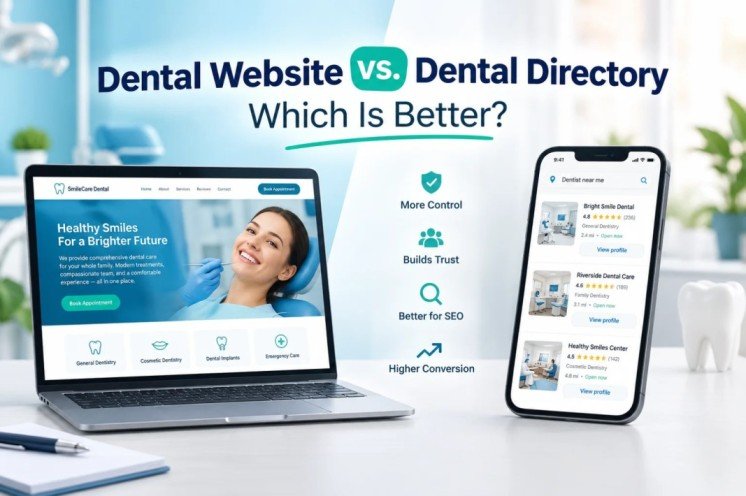
When someone searches for a dentist in their area, they may find dental practices through Google, a dental directory, social media, or the practice’s own website. Dental directories can be useful for getting your practice discovered, but there is an important difference between being listed on a directory and having a professional website that your practice controls.
So, which is better for a dental practice: a dental website or a dental directory?
For most dental practices in the United States, the answer is not really about choosing one over the other. A directory can help people discover your practice, while your own website gives those potential patients a place to learn about your services, evaluate your practice, build confidence, and take the next step.
The strongest online presence usually uses both—but your own dental website should be the foundation.
Dental Website vs. Dental Directory: At a Glance
| Factor | Dental Website | Dental Directory |
|---|---|---|
| Brand control | High | Limited |
| Design control | Complete | Usually limited to a profile template |
| Patient experience | Can be customized | Mostly controlled by the directory |
| Service information | Detailed and customized | Usually limited |
| Appointment conversion | Can be designed around bookings | Depends on directory features |
| Local SEO opportunities | Strong | Usually limited |
| Google visibility | Can target many relevant searches | Depends on directory authority |
| Patient education | Extensive | Limited |
| Reviews | Can display selected reviews and testimonials | Usually directory-controlled |
| Ownership | You control the website | Directory controls the platform |
| Long-term asset | Yes | No |
| Branding | Fully customized | Shared directory environment |
| Marketing flexibility | Very high | Limited |
| Best use | Main online presence | Additional discovery channel |
This difference becomes especially important for dental practices competing in busy U.S. markets, where patients can have many dentists to choose from.
What Is a Dental Directory?
A dental directory is an online platform where patients can search for dentists and dental practices.
A typical directory profile may include information such as:
- Practice name
- Dentist name
- Address
- Phone number
- Office hours
- Dental services
- Patient reviews
- Photos
- Insurance information
- Appointment options
Directories can be helpful because they already attract people who are looking for healthcare providers.
For example, a patient searching for a dentist may visit a directory, compare several practices, read reviews, and then decide which office to contact.
That makes directories useful—but there is a major limitation.
You do not fully control the experience.
Your profile exists inside someone else’s platform, alongside other dental practices.
What Is a Dental Practice Website?
A dental practice website is a website owned and controlled by the dental practice.
Instead of fitting your information into someone else’s profile layout, you can build an online experience specifically around your practice, your patients, your services, and your brand.
A professionally designed dental website can include:
- Homepage
- About the dentist or dental team
- Individual service pages
- New patient information
- Appointment request forms
- Contact information
- Before-and-after galleries
- Patient testimonials
- Frequently asked questions
- Insurance information
- Emergency dental information
- Blog or educational resources
- Location pages
- Google Maps
- Financing information
- Accessibility features
- Mobile-friendly navigation
This gives a dental practice considerably more control over how potential patients experience the brand.
If your practice specializes in cosmetic dentistry, dental implants, orthodontics, emergency dentistry, family dentistry, or another service, your website can give each important service its own dedicated page.
That is much harder to accomplish with a standard directory profile.
Why a Dental Website Is More Valuable for Your Brand
Imagine that a patient sees your practice on a dental directory.
They may like your reviews and click your profile.
But what happens next?
If the directory sends them to your website, you have an opportunity to turn that visitor into a patient.
Your website can answer the questions they still have:
Who is the dentist?
What treatments does the practice offer?
Does the office look professional?
Where is the practice located?
Does the dentist treat patients like me?
Does the practice accept my insurance?
How can I schedule an appointment?
A directory listing usually cannot provide the same depth of information.
Your website can.
A Website Gives You More Control Over Patient Trust
Choosing a dentist is different from buying an inexpensive product online.
Patients want to feel comfortable with the provider they are considering.
The website is often one of the first places where that trust is developed.
A well-designed dental website can introduce the dentist, show the office environment, explain treatments in understandable language, highlight patient experiences, and make the practice feel approachable.
For example, a dental website could include a section such as:
“Meet Dr. Smith”
followed by a professional photograph, qualifications, experience, treatment philosophy, and a short personal introduction.
The practice can also show photographs of the office, treatment rooms, team members, and patient-friendly amenities.
These details help transform an anonymous online listing into a recognizable dental brand.
Dental Website vs. Directory for Local SEO
Local SEO is another important difference.
A dental directory may rank well for searches related to dentists because of its large website and established authority. However, the directory is competing for its own visibility.
Your dental website can target searches specifically related to your practice, services, and location.
For example, a dental practice in Chicago might create useful pages targeting topics such as:
| Search Intent | Example Website Page |
|---|---|
| General dentist | General Dentistry |
| Cosmetic treatment | Cosmetic Dentistry |
| Dental implants | Dental Implants |
| Emergency treatment | Emergency Dentist |
| Family services | Family Dentistry |
| Location | Dentist in Chicago |
| New patients | New Patient Information |
| Specific treatment | Dental Crowns |
| Educational search | How Long Do Dental Implants Take? |
The important point is that these pages should be created because they are genuinely useful to patients—not simply to create pages containing keywords.
Google’s guidance specifically recommends people-first content that provides substantial value rather than creating pages primarily for search rankings.
A Dental Website Can Target More Than One Search
One of the biggest advantages of owning your website is the ability to build a complete content structure.
A dental directory profile might contain a short description of your practice and a list of services.
Your own website can go much deeper.
For example, a dental implant practice could have:
Dental Implants
→ Dental Implant Consultation
→ Single-Tooth Implants
→ Multiple Dental Implants
→ Full-Arch Implants
→ Dental Implant FAQs
→ Dental Implant Cost Information
→ Dental Implant Recovery
Each page can serve a different patient question or search intent.
This creates a much broader opportunity to attract people throughout the research process.
Which One Builds More Brand Recognition?
A directory promotes many dentists.
Your website promotes your dental practice.
That distinction matters.
When a patient visits a directory, they may see your practice next to several competitors. Your practice is one option among many.
On your own website, the visitor sees your:
- Logo
- Colors
- Dentist
- Team
- Office
- Services
- Reviews
- Photos
- Brand message
- Appointment process
There are no competing dental practices displayed directly beside your homepage.
That gives you a better environment for communicating what makes your practice different.
Which One Is Better for Patient Conversion?
Getting traffic is only part of dental marketing.
The bigger question is:
What happens after someone visits?
A dental website can be designed specifically around conversion.
For example, important calls to action can include:
| Patient Need | Website Conversion Element |
|---|---|
| Wants an appointment | Request an Appointment button |
| Has a question | Contact form |
| Wants to call | Click-to-call phone number |
| Needs directions | Google Maps/location section |
| Wants to know about treatment | Dedicated service page |
| Wants reassurance | Reviews and testimonials |
| Is a new patient | New patient information |
| Wants to compare treatments | Treatment comparison content |
A professional website should not force visitors to search around for basic information.
The next step should be obvious.
What Happens If Your Dental Directory Profile Changes?
Another important issue is ownership.
Your website is a long-term digital asset for your practice.
A directory can change its:
- Pricing
- Features
- Profile layout
- Search algorithm
- Advertising model
- Terms
- Visibility rules
Your practice has limited control over those changes.
With your own website, you control the structure and content.
That does not mean a directory is useless. It means a directory should generally be viewed as an additional marketing channel, rather than the foundation of your entire online presence.
Should Dentists Stop Using Dental Directories?
No.
That would be the wrong conclusion.
Dental directories can still be valuable for discovery, citations, reviews, referrals, and additional online visibility.
The better strategy is to give each platform a specific role.
Think of it this way:
Dental directory = discovery
Dental website = destination
A potential patient might discover your practice through a directory, Google Search, social media, an advertisement, or a referral.
Eventually, many of those people may want to visit your website before deciding whether to contact you.
That is why your website should be ready to answer their questions.
The Best Strategy: Use Both
For a dental practice in the USA, I would not recommend treating this as an either-or decision.
A stronger online marketing setup looks more like this:
Google Search → Dental Directory / Social Media / Advertisement → Dental Website → Contact or Appointment
Or:
Dental Directory → Practice Website → Service Information → Appointment Request
Each channel has a different job.
The directory can help people discover the practice.
The website can help them understand the practice.
The appointment system can help convert that interest into an actual inquiry.
What Should a Professional Dental Website Include?
If your practice is investing in a new website, design should not be the only consideration.
The website should support both the patient’s experience and the practice’s marketing goals.
Here are some of the most important components:
1. Professional Homepage
The homepage should immediately communicate:
- Who you are
- Where you are located
- What you offer
- Why patients should consider your practice
- How to schedule an appointment
2. Dedicated Dental Service Pages
Instead of placing every service into one large paragraph, important treatments should have their own pages.
For example:
Dental Implants
Cosmetic Dentistry
Emergency Dentistry
Family Dentistry
Teeth Whitening
Dental Crowns
This makes the website easier for patients to navigate and creates opportunities to provide detailed information about individual treatments.
3. Mobile-Friendly Design
A large percentage of potential patients will visit your website from a smartphone.
The website needs to work properly across phones, tablets, and desktop computers.
Buttons should be easy to tap, text should be readable, and appointment/contact options should be easy to find.
4. Strong Calls to Action
Do not make patients hunt for your phone number.
Useful calls to action include:
Book an Appointment
Request an Appointment
Call Our Office
Contact Our Dental Team
These should be visible throughout the site without becoming annoying or intrusive.
5. Trust-Building Content
A dental website should make patients feel comfortable.
Useful trust signals include:
- Dentist biography
- Team photographs
- Office photographs
- Patient testimonials
- Credentials
- Treatment information
- Frequently asked questions
- Financing information
- Insurance information
6. Fast Website Performance
A beautiful website that takes too long to load can still create a poor experience.
A dental website should be built with performance in mind, including optimized images, efficient code, reliable hosting, and a responsive design.
7. Local SEO Foundation
Your website should make it clear where the practice operates and what services it provides.
Location information, relevant service pages, consistent business information, descriptive page titles, useful content, and appropriate structured data can all contribute to a stronger local SEO foundation.
Dental Website vs. Dental Directory: Which Is Better for a Growing Practice?
If you are opening a new dental practice, a directory profile can be a quick way to establish another online presence.
But I would still prioritize building your own website early.
Why?
Because your website can grow with your practice.
At first, you may only need a homepage, about page, services, contact page, and appointment information.
Later, you can add:
- More treatment pages
- FAQs
- Blog articles
- Location pages
- Patient resources
- Before-and-after galleries
- Financing information
- Landing pages
- Online booking
- Conversion-focused campaigns
A directory profile generally does not give you that level of flexibility.
How Much Should a Dental Practice Invest in Its Website?
There is no single price that applies to every dental website.
A small local practice may need a relatively simple website, while a multi-location dental group may require a much larger project.
The cost can depend on:
| Project Factor | Why It Matters |
|---|---|
| Number of pages | More pages require more planning and development |
| Custom design | Unique designs require additional design work |
| Service pages | Detailed treatment pages increase content requirements |
| Booking system | Appointment functionality may require integrations |
| SEO | Research and optimized content add project scope |
| Photography | Professional images can improve trust and presentation |
| Copywriting | High-quality patient-focused content takes time |
| Integrations | CRM, forms, analytics, and marketing tools can add complexity |
| Maintenance | Websites need ongoing updates and security management |
Rather than choosing a website based only on the lowest price, dental practices should consider whether the website will actually support patient acquisition and long-term marketing.
When Should a Dental Practice Redesign Its Website?
A redesign may be worth considering if your current website:
- Looks outdated
- Is difficult to use on mobile devices
- Loads slowly
- Has confusing navigation
- Makes appointments difficult to request
- Does not clearly explain your services
- Has outdated information
- Does not represent the quality of your practice
- Has weak calls to action
- Is difficult to update
- Has poor local SEO foundations
Your website does not need to follow every design trend.
It needs to make the practice look trustworthy, explain the services clearly, and make it easy for the right patients to take action.
Dental Website or Dental Directory: The Final Verdict
So, which is better—a dental website or a dental directory?
For long-term growth, a professional dental website is the stronger foundation.
A dental directory can help your practice get discovered, but your own website gives you much greater control over branding, patient education, SEO, content, user experience, and conversions.
The smartest approach is not to abandon directories.
Instead, use them together.
Your directory listings can help people discover your practice.
Your website can give them the information they need to choose you.
And your appointment or contact system can turn that interest into a real patient inquiry.
Build Your Dental Practice’s Online Presence Around Your Own Website
If your dental practice needs a modern website that is designed around patient experience, branding, mobile usability, and lead generation, I can help.
I specialize in WordPress dental website design for dental practices and healthcare businesses. A dental website should be more than a digital business card—it should clearly communicate your services, build patient confidence, and make it easy for potential patients to contact your practice.
You can learn more about my Dental Website Design service and see more about my work and services on my portfolio website.
Whether you are launching a new dental practice, redesigning an outdated website, or trying to improve your existing online presence, the goal should be the same:
Create a website that makes it easier for the right patients to find, trust, and contact your dental practice.